
Real Estate Investment Trust Yields Volatility and Dubai Opportunities for 2026
· 20 min read

Introduction
What if you could earn from Dubai’s booming property market without the hassle of buying a villa or dealing with tricky tenants?
That is the promise of a real estate trust investment. A Real Estate Investment Trust, or REIT, lets you invest in income-producing properties without owning them directly. Instead of managing maintenance or chasing rent checks, you own shares in a portfolio of buildings.
The global REIT market is growing fast. According to a recent market analysis, the market is expected to grow by USD 397.6 million from 2026 to 2030, driven by demand for liquid real estate exposure. Overall, REITs now make up a massive part of global finance, covering markets across 40+ countries.
But here is the thing. Many investors still struggle. They face fragmented management options, confusing regulations, and yields that do not always meet expectations. This is especially true in dynamic markets like Dubai, where choosing the right fund or property manager can feel overwhelming. You need a clear strategy, not just guesswork.

This guide is built to change that. We will break down the top real estate investment trusts, explain how to evaluate them, and share actionable strategies to maximize your returns. Whether you are looking at a singapore real estate investment trust or a Dubai-specific fund, the principles of smart trust investing apply.
If you want to explore specific real estate trust investment opportunities in Dubai, getting expert advice helps a lot. Connect with Ayaz Salman for a free Dubai real estate consultation to discuss your portfolio goals.
Let us dive into the data and find the best path for your investments.
What is a Real Estate Investment Trust (REIT)?
Imagine owning a slice of a downtown Dubai skyscraper or a shopping mall in Singapore without having to buy the whole building. That is exactly what a REIT lets you do.
A Real Estate Investment Trust (REIT) is a company that owns and operates income-producing real estate. Think hotels, office towers, apartment complexes, and warehouses. When you buy shares in a REIT, you become a part-owner of that property portfolio. You earn a share of the rental income without ever dealing with a leaky faucet or a late-paying tenant.
The Three Main Types of REITs
Not all REITs work the same way. There are three main structures you should know about:
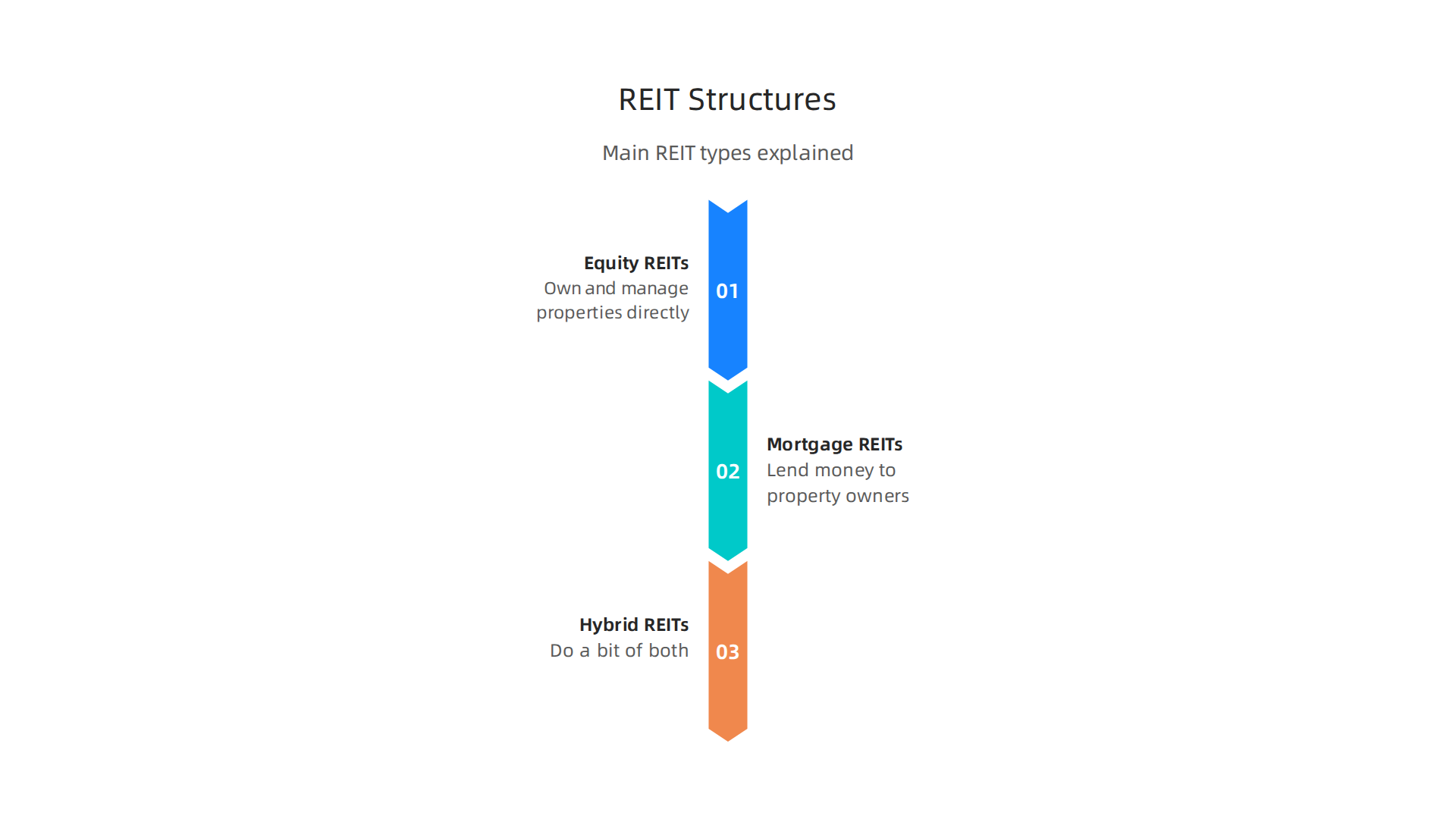
- Equity REITs. These own and manage properties directly. They make money from rent. Most REITs fall into this category.
- Mortgage REITs (mREITs). These do not own buildings. Instead, they lend money to property owners or buy mortgage-backed securities. They earn from the interest on those loans.
- Hybrid REITs. These do a bit of both. They own some properties and also hold mortgages.
Why Investors Love REITs
Here is the real appeal. REITs offer three big advantages that direct property ownership often cannot match.
Liquidity. You can buy or sell REIT shares on major stock exchanges almost instantly. Try selling a villa in Dubai that fast. It is not easy.
Diversification. A single REIT might own properties across 40+ countries according to Nareit. You get exposure to multiple markets with one purchase. This matters if you are looking at a Singapore real estate investment trust or a fund focused on the Middle East.
Regulated dividends. By law, REITs must distribute most of their taxable income to shareholders as dividends. That means predictable, often generous, payouts.
The global REIT market is already massive. According to a Grant Thornton report, market capitalization hit USD 1.54 trillion. And the sector keeps growing. A Technavio analysis projects growth of USD 397.6 million from 2026 to 2030.
So whether you consider yourself a passive investor or someone actively building wealth, understanding the top real estate investment trusts gives you a powerful tool.
If you are thinking about how real estate trust investment fits into your Dubai portfolio, expert guidance helps. Connect with Ayaz Salman for a free Dubai real estate consultation to explore your options.
Next, we will look at how to evaluate the best REITs and find the ones that match your goals.
Global REIT Market Overview
So what does the global REIT landscape look like in 2026? It is bigger and more connected than ever.
The numbers are impressive. The global REIT market capitalization has already reached a staggering USD 1.54 trillion according to a Grant Thornton report. And the growth is not slowing down. A Technavio analysis projects the market will expand by USD 397.6 million between 2026 and 2030, growing at a compound annual rate of 3.1%.
Regional Highlights
The market is not the same everywhere. Here is how the regions break down:
- United States. The US REIT market leads the pack with a healthy growth rate of around 17.9% CAGR, as noted in the same Grant Thornton report. It is the engine that drives the global bus.
- Europe. European REITs are more modest but still steady, with a 4.6% CAGR.
- Asia and the Middle East. Markets in Asia and the Middle East offer something special. According to a Neuberger Berman analysis, these regions maintain a low correlation with US markets. That means they can provide real diversification in your portfolio.
Top Performing Sectors in 2026
Right now, certain sectors are standing out. The PGIM Global REIT Securities Update highlights that REITs have been relative outperformers even during recent market volatility. Data centers, logistics warehouses, and healthcare properties are leading the charge. These sectors benefit from strong secular trends like cloud computing, e-commerce, and aging populations.
How Global Trends Affect the Dubai REIT Market
Here is where it gets personal if you are investing in Dubai. Global capital flows directly impact Dubai real estate prices. When international investors look for stable yields, Dubai often comes up as a top destination. A strong global REIT market pushes more money toward high-yield markets like the UAE.
This is why understanding the link between global trends and local markets matters.

If you are thinking about how a real estate trust investment fits into your Dubai portfolio, it helps to see the big picture.
Ready to find the right Dubai property for your investment goals? Connect with Ayaz Salman for a free Dubai real estate consultation to explore your options.
Market Size and Growth Trends
How did we get here? Let us look at the numbers.
The global REIT market has come a long way since 2020. Back then, the pandemic hit hard. But by 2024, the market had rebounded to a value of USD 2.18 trillion, according to a SkyQuest report. Fast forward to 2026, and estimates put the market around USD 4.67 trillion, per Global Market Statistics. That is a massive jump.
But the ride has not been smooth. Higher interest rates have put pressure on REIT valuations. In fact, the Nareit blog reports that global REITs saw a negative return of 13.3% in 2025, mostly because of North America. Higher rates make borrowing more expensive, which can squeeze profits. Inflation, on the other hand, has helped certain property types like residential and industrial, where rents rise faster.
What about the future? Analysts see steady growth ahead. The Technavio forecast expects the market to expand by USD 397.6 million from 2026 to 2030 at a 3.1% compound annual rate. Other researchers are even more bullish. Market Research Future projects a 7.43% CAGR from 2025 to 2034, pushing the market to USD 8.785 billion by 2035. That is a wide range, so it pays to watch the trends closely.
Regions like Asia Pacific are leading the recovery. For example, a PwC report notes that Southeast Asia remains one of the fastest-growing areas. This is good news if you are looking at a real estate trust investment in markets like Singapore. In fact, investors often compare the singapore real estate investment trust sector to Dubai for stable yields.
Understanding these trends helps you spot opportunities. Whether you are new to REITs or you already own some, staying informed gives you an edge. That is where expert guidance matters.
Ready to apply these insights to your Dubai portfolio? Get a free Dubai real estate consultation with Ayaz Salman to discuss your next move.
Regional Performance: US, Europe, and Asia-Pacific
Not all REIT markets perform the same. If you are considering a real estate trust investment, you need to know how regions compare.
The US, home to many top real estate investment trusts, struggled in 2025. North America saw a 14.1% decline due to high rates, according to the Nareit blog. Europe looks even slower. A PwC report calls it the lowest growth region among the three.
Asia-Pacific is different. The region posted nearly flat returns in 2025 but is now rebounding. Global transaction volumes hit $216 billion in Q1 2026, with Asia Pacific leading, per JLL Research. Southeast Asia grew 4.8% in 2025, according to the Asia Pacific Real Assets Association. This makes the Singapore real estate investment trust market attractive for yield seekers.
What about the UAE? Dubai offers high rental yields and investor friendly rules. Many compare real estate investment trusts in Singapore to direct Dubai property investments. The regulatory environment here is also improving.
To learn how to link your real estate investment trust strategy to Dubai opportunities, check out our guide on Dubai market trends and rental yields.
Ready to take the next step? Get a free Dubai real estate consultation with Ayaz Salman.
The Rise of REITs in Dubai and the UAE
Now that you have seen how different regions compare, let us zoom in on a place that is quickly becoming a major player in real estate trust investment: Dubai. The UAE is building a strong market for these products, and the growth is worth watching.

The story of real estate investment trusts in Dubai started in 2010. That is when Emirates REIT was launched, becoming the first Sharia-compliant REIT in the country. It still manages a large portfolio today, according to its official site at reit.ae. Since then, more top real estate investment trusts have joined the Dubai Financial Market (DFM). The DFM page lists several options for investors.
In 2025, Dubai Holding announced plans to bring Dubai Residential REIT to the market. This was a big moment. The press release said it would be the largest listed REIT in the GCC. Later, the price was set at AED 1.10 per unit, raising AED 2.1 billion, as reported by the Media Office. You can also check investor details on the Dubai Residential site.
Other well-known names include SEDCO Capital, Al Rajhi Capital, and ENBD REIT. These REITs own everything from offices to shopping centers and homes. The government has helped by creating clear rules for REITs on the DFM. This makes it easier for you to link real estate investment trust strategies to Dubai.
If you want to compare a Singapore real estate investment trust with a Dubai option, you need local guidance. To understand the broader market, read our guide on Dubai real estate investment strategies for high yields.
Are you ready to explore real estate trust investment in Dubai? Get a free consultation with Ayaz Salman to start your journey.
Comparing REIT Performance: Yields, Volatility, and Liquidity
Not all real estate trust investment options perform the same. When you compare top real estate investment trusts, you need to look at a few key numbers. This helps you build a stronger portfolio that matches your goals.
Here are the main metrics to check:
-
Dividend yield – This shows the annual income you get compared to the price you pay. REITs must pay out at least 90% of their taxable income as dividends, according to NerdWallet. Some high‑yield REITs offer yields up to 20%, but those can come with higher risk, as noted in a Sure Dividend report.
-
Total return – This combines dividend income plus any price change. It gives you the full picture.
-
Sharpe ratio – This measures how much extra return you get for the risk you take. A higher Sharpe ratio means better risk‑adjusted performance.
So how do Dubai REITs stack up against global benchmarks? According to the REIT Industry Financial Snapshot from Nareit, the FTSE Nareit All REITs yield was 4.04% in April 2026. Dubai REITs like Emirates REIT and Dubai Residential REIT often offer yields in a similar range, but with lower volatility because the UAE market is still growing. If you compare a Singapore real estate investment trust, you might see slightly different yields due to market maturity.
To link real estate investment trust performance to your own strategy, you need to understand the basics first. Read our guide on real estate investment trusts explained to get up to speed.
Ready to pick the right REIT for your portfolio? Get a free consultation with Ayaz Salman and start comparing your options today.
Yield Analysis
So now that you know the basic metrics, let us zoom in on the number most investors check first: yield. In April 2026, the global REIT average yield was 4.04%, according to the REIT Industry Financial Snapshot from Nareit. Some funds offer much higher yields, but those can come with added risk, as Sure Dividend points out.
Dubai REITs like Emirates REIT often compete well here. Their yields sometimes match or beat global averages because the local market is still growing fast. Compare that to a Singapore real estate investment trust, which offers more stability but slower growth.
Yield depends on a few key factors:
- Sector: Residential, commercial, and industrial REITs all behave differently.
- Occupancy rates: Higher occupancy usually means steadier dividends.
- Lease structures: Long term leases give stable yields. Short term leases can offer higher yields but with more ups and downs.
This brings us to an important choice in any real estate trust investment: yield stability versus growth potential. Top real estate investment trusts balance both. They provide a solid income today with room for that income to grow tomorrow.
Want to see how these factors affect your options right now? Read our guide to Dubai real estate investment in 2026 and high rental yields.
Not sure which yield profile fits your needs best? Get a free consultation with Ayaz Salman. You can compare options that match your income goals and comfort with risk.
Volatility Metrics
Yield tells you the reward. Volatility tells you about the risk. For any real estate trust investment, you need to understand both.
The most common way to measure volatility is beta. Beta shows how much a REITs price moves compared to the overall stock market. A beta of 1.0 means it moves in line with the market. A beta below 1.0 means it is less volatile. The Oliva glossary gives a clear definition of beta for property assets.
Here is the good news. Most REIT sectors actually reduce the volatility in a mixed portfolio. According to Nareit, almost every REIT sector has a beta below 1. This means they can make your overall investment ride smoother.
Standard deviation is another metric you will see. It measures how far returns swing from the average. A lower standard deviation means more stable returns.
How do Dubai REITs compare? The market here is still growing. You saw the recent news about the Dubai Residential REIT floating on the DFM. Younger markets can sometimes bring higher volatility. On the other hand, PGIM notes that REITs globally are proving resilient even in uncertain times.
If you compare a Dubai REIT to a Singapore real estate investment trust, you might notice the Singapore option has lower volatility. That is because its market is more mature. But Dubai REITs often offer higher growth.
Want to learn more about how these metrics work in practice? Read our full guide on real estate investment trusts explained.
Not sure how much volatility fits your plan? You can get a free consultation with Ayaz Salman to match your risk comfort with the right property strategy.
Liquidity Considerations
Volatility matters, but so does liquidity. For any real estate trust investment, you need to know how quickly you can turn your shares into cash.
The biggest advantage of a listed REIT over buying a physical property is liquidity. You can trade shares on the stock exchange in seconds. Selling an actual apartment in Dubai can take months. The PDF on REITs and liquidity in real estate markets shows that REITs bring a clear liquidity benefit to real estate investing.
In Dubai, the market is still growing. New listings like the Dubai Residential REIT on the DFM are adding more options. You can explore the full list of REITs on the Dubai Financial Market to see what is available. Trading volumes and bid-ask spreads depend on how many investors are active in a particular REIT. Larger REITs tend to have tighter spreads and better liquidity.
Market size plays a role too. A singapore real estate investment trust often trades with higher volume because Singapore has a more mature market. But Dubai REITs can still offer good liquidity, especially for the top real estate investment trusts in the region. Research on property market liquidity and REIT liquidity also shows that less volatile REITs tend to have more liquid shares, which is a nice bonus.
If you want to understand how liquidity fits into your overall Dubai strategy, our Dubai real estate investment 2026 guide to market trends and high rental yields can help you put the pieces together.
Still unsure which REIT matches your need for liquidity? Get a free consultation with Ayaz Salman to talk through your options.
How to Invest in Real Estate Trusts in Dubai
By now you know what a real estate trust investment is and how liquidity works. The next step is actually putting your money to work. Here is a simple guide to getting started with top real estate investment trusts in Dubai.
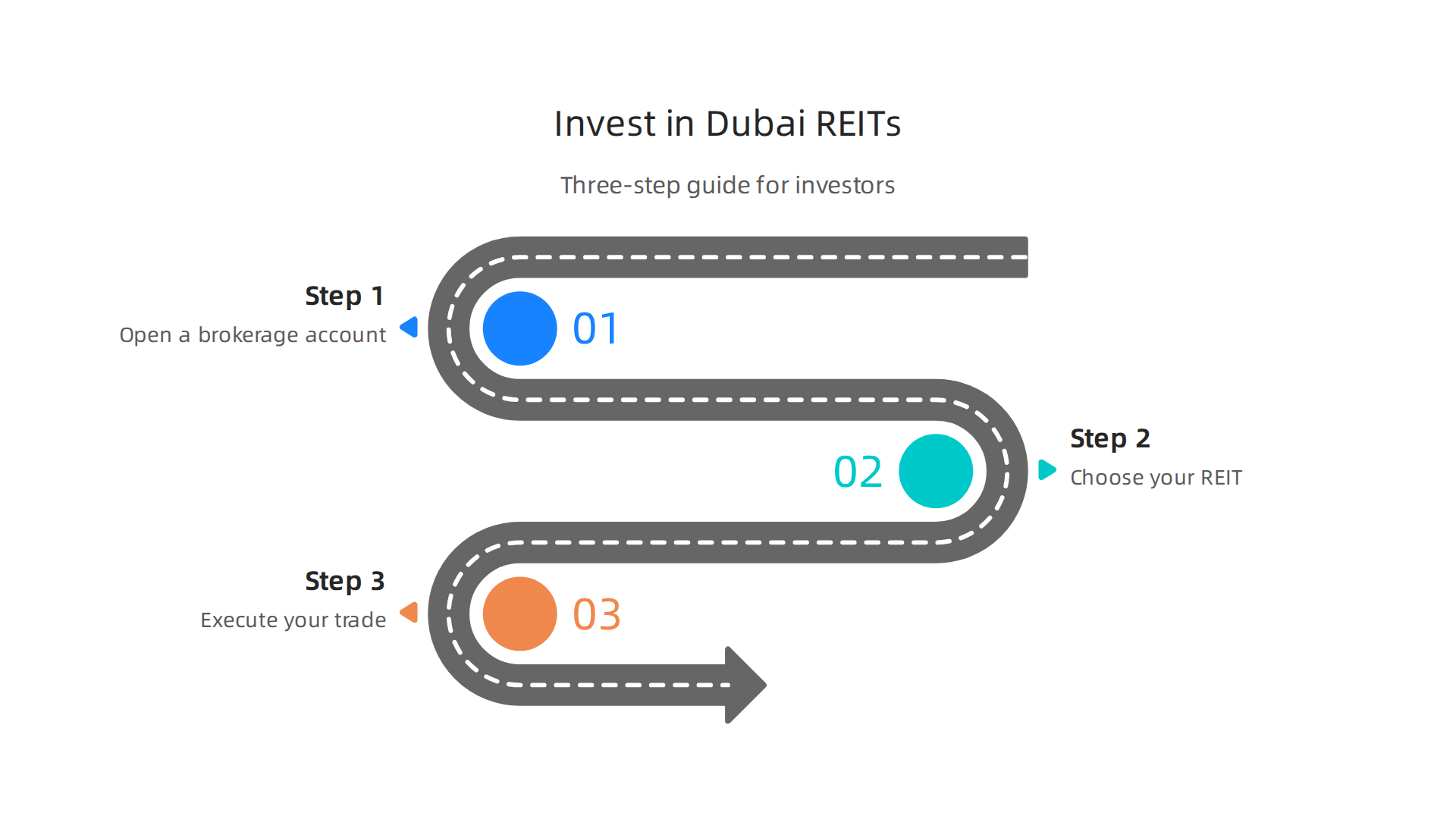
Step 1: Open a brokerage account. You need a trading account with a licensed broker that offers access to the Dubai Financial Market (DFM). Most major UAE banks let you trade REIT shares directly through their platforms. You can also use online brokers. The DFM page listing all available REITs is a good starting point to see what you can buy.
Step 2: Choose your REIT. Look at the options. Emirates REIT is one of the oldest and largest Sharia-compliant trusts in the UAE. In 2026, the new Dubai Residential REIT became the largest listed REIT in the GCC after its IPO. A guide from Land Sterling breaks down the best performers to help you compare.
Step 3: Execute your trade. Buy shares just like you would buy a stock. You can invest a small amount or a large one. There is no minimum that is out of reach.
Tax implications for expat investors. The good news? The UAE has no personal income tax or capital gains tax. For non-residents, REIT dividends paid in Dubai are generally tax-free locally. But check your home country rules, as some nations still tax foreign dividends.
Due diligence tips. Always read the fund’s financial reports. Look at occupancy rates, fee structures, and the track record of the management team. Recent data shows Dubai REIT occupancy rates hit 98% in early 2026, which is a strong sign for income stability.
If you want to learn more about how REITs compare to direct property ownership, our real estate investment trusts explained guide covers the basics in plain language.
Not sure which REIT fits your goals? Connect with Ayaz Salman for a free consultation to get personalized advice.
Risks and Regulatory Considerations for Dubai REIT Investors
You now know how to buy shares in a real estate trust investment. But before you jump in, it helps to understand the risks and the rules that protect you.
Interest rate sensitivity. When interest rates rise, borrowing costs for REITs go up, which can eat into profits. This is a real concern, especially for mortgage-linked REITs. IG explains that REITs are sensitive to rate changes. Academic research from Stern NYU also shows how equity REITs respond to these shifts.
Sector concentration. Many Dubai REITs focus on just one type of property, like offices or retail spaces. If that sector slows down, your investment feels the pain. As Gaia Living notes, geographic and property-type concentration can put you at risk.
Management quality matters too. A poorly run REIT can hurt returns. Always check the team’s track record and fee structure.
How to protect yourself. The best move is to spread your money across different top real estate investment trusts and sectors. A Driven Properties guide highlights how diversification reduces risk. Also, Dubai’s regulator (the SCA) requires regular financial reports and disclosures. That transparency helps you make informed choices, as outlined in this REIT guide.
For more on building a balanced approach, check out our Dubai real estate investment 2026 guide on picking the right opportunities.
Still not sure which REIT fits your plan? Connect with Ayaz Salman for a free consultation and get personalized advice.
Future Outlook: Trends Shaping the REIT Market in 2026 and Beyond
So what does the next few years look like for real estate trust investment in Dubai? Actually, the signs are pretty exciting. Several big trends are pushing the market forward, and more investors are paying attention.
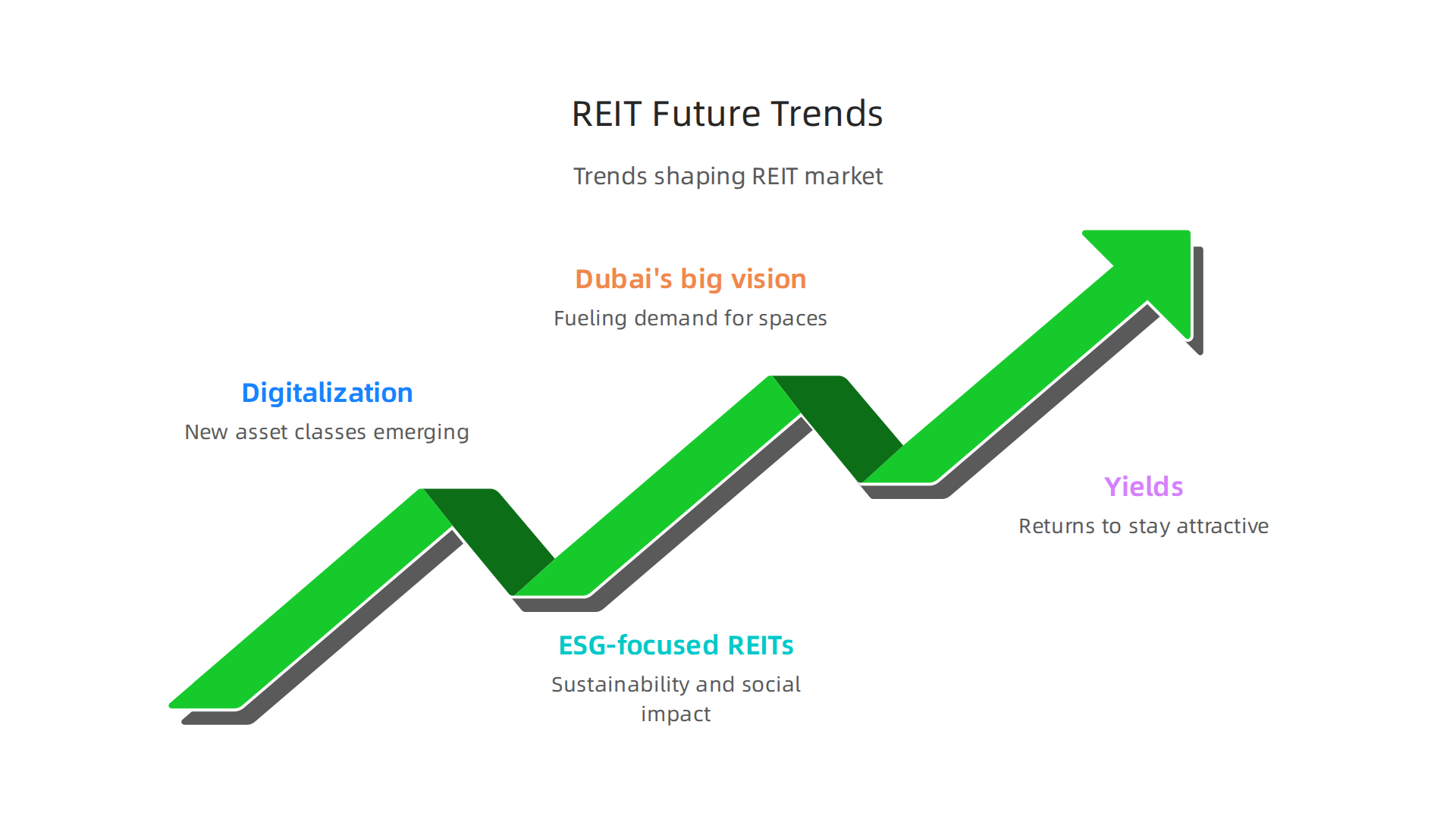
Digitalization and new asset classes are taking over. REITs are no longer just about offices and shopping malls. We are seeing funds move into data centers, healthcare facilities, and even residential rental properties. A great example is the upcoming Dubai Residential REIT, which will list on the Dubai Financial Market with the symbol RESI. This shows how the market is opening up to new opportunities.
ESG-focused REITs are also on the rise. Investors care more about sustainability and social impact. Properties that are green and energy-efficient tend to attract better tenants and hold value longer. Real estate investment trusts in singapore and other global markets have already proven this, and Dubai is catching up fast.
Dubai’s big vision helps too. The legacy of Expo 2020 and the D33 economic agenda are fueling demand for commercial and residential spaces. More businesses and people are moving here, which means more need for quality properties. That is good news for top real estate investment trusts that own those assets.
What about yields? Experts expect REIT returns to stay attractive over the next three to five years, especially as interest rates stabilize. The market is also becoming more liquid, which makes it easier to buy and sell shares. You can check out the full list of REITs on the DFM to see what is available today.
If you want to understand how REITs fit into your bigger plan, take a look at our detailed guide on real estate investment trusts explained.
Still not sure where to put your money next? Connect with Ayaz Salman for a free consultation and get personalized advice for 2026.
Summary
This article explains real estate investment trusts (REITs) and shows how they let you own shares of income-producing property without direct management. It covers the three main REIT types, the global market size and regional performance, and why REITs offer liquidity, diversification, and regulated dividends. The guide zooms into Dubai — recent listings, market dynamics, yields, and how Dubai REITs compare with mature markets like Singapore. You’ll learn the key metrics to evaluate (yield, total return, volatility, liquidity), practical steps to buy Dubai REITs, and the main risks and regulatory points to watch. The piece also outlines future trends such as ESG, new asset classes, and market growth drivers, and invites readers to get a free consultation to apply these insights to their portfolio.