
Real Estate Investment Trusts Explained What They Are and How They Work
· 19 min read

Introduction: Unlocking Passive Real Estate Investment with REITs
Real estate has always been one of the best ways to build long term wealth. But let’s be honest. Buying a property directly comes with a lot of headaches. You need a huge pile of cash for a down payment. You have to deal with tenants, repairs, and property management. And if something goes wrong, your money is stuck in a building you cannot sell quickly. For expat and high net worth investors in Dubai, these challenges get even harder. Navigating local rules, comparing service providers, and staying on top of things from another country can eat into your profits fast.
So what if you could invest in real estate without all that stress?

That is exactly what a real estate investment trust (REIT) offers. A REIT is a company that owns and runs income producing properties like office buildings, shopping malls, and apartment complexes. In simple terms, it is a way to invest in real estate without actually buying a physical property. You buy shares in the company instead.
According to the U.S. Securities and Exchange Commission, REITs have been around for more than 50 years and were created so everyday investors could benefit from big real estate projects. The Investor.gov page defines a REIT as a company that owns and typically operates income producing real estate or related assets.

For those exploring the Dubai market, understanding traditional options first helps. For example, our guide on Dubai real estate investment 2026 offers a full look at market trends and high rental yields. But for investors who want simplicity, liquidity, and diversification, REITs provide a powerful alternative. You get exposure to a portfolio of properties spread across different sectors and locations, all managed by professionals.
In this article, we will break down what are real estate investment trusts, how they work, and why they matter for your portfolio in 2026.
What Exactly Is a Real Estate Investment Trust (REIT)?
So let’s get to the heart of it. A real estate investment trust, or REIT (pronounced "reet"), is simply a company that owns, operates, or finances income-producing real estate. Think of it like a mutual fund for buildings. Instead of buying a single apartment or office, you buy shares in a company that owns a whole portfolio of properties. This gives you a slice of the rental income and property value gains without the hassle of being a landlord.
According to the U.S. Securities and Exchange Commission, REITs have been around for more than 50 years. Congress created them in 1960 so regular people could invest in large scale real estate projects. Today, the SEC explains that a REIT typically owns and operates income-producing assets like office buildings, shopping malls, hotels, and apartment complexes.
How a REIT Is Structured
Here is the key part that makes REITs special. By law, a REIT must distribute at least 90% of its taxable income to shareholders as dividends.
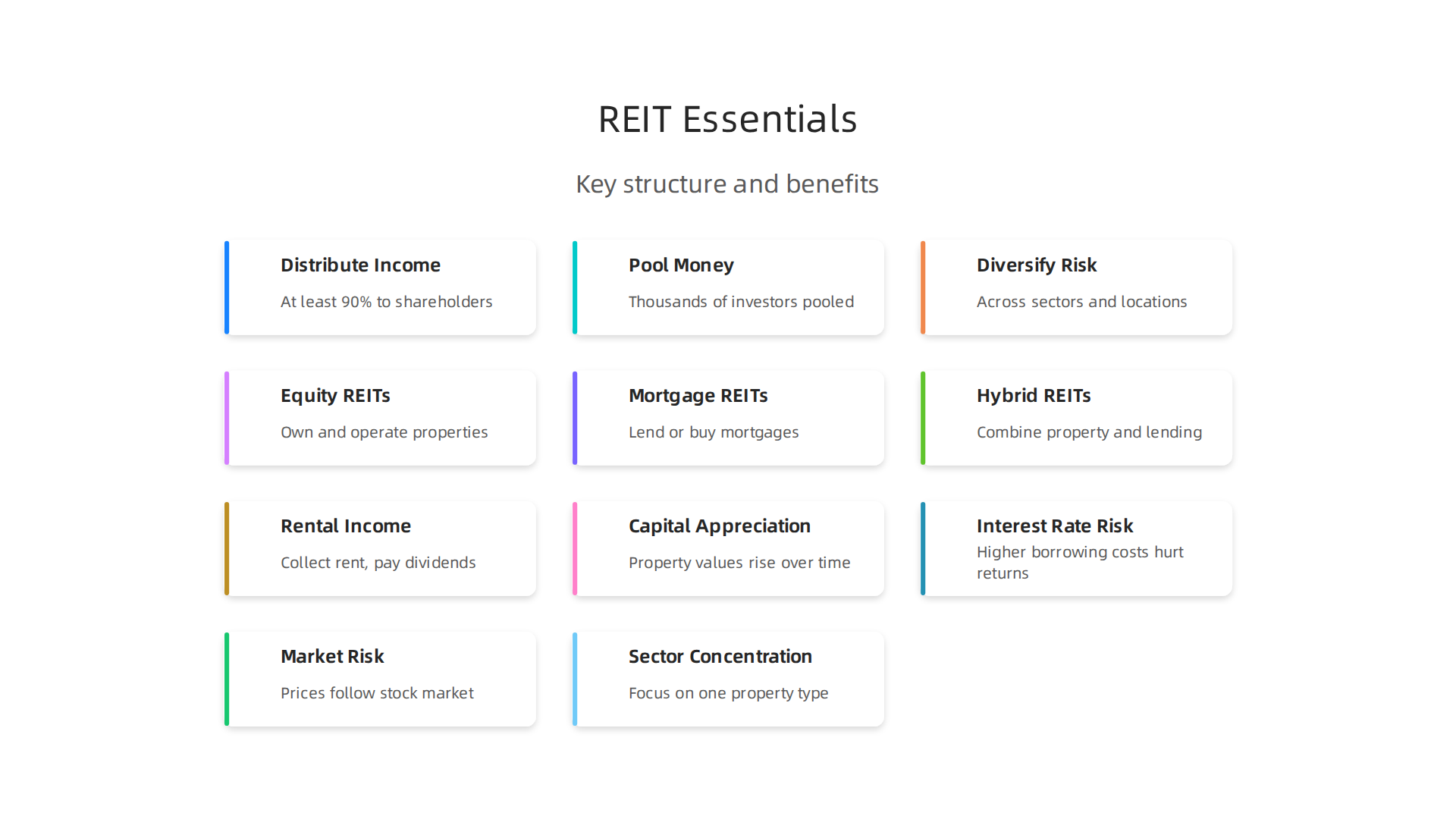
That rule, laid out in IRS requirements, means these trusts pay out most of their profits. This is why REITs often offer higher dividend yields than many other stocks. As the Nareit website notes, REITs own or finance income-producing real estate across many property sectors.
REITs pool money from thousands of investors. This allows them to buy institutional-quality properties that an individual could never afford alone. A single REIT might own office towers in New York, warehouses in Dubai, and apartment complexes in London. This diversification spreads risk. If one type of property struggles, others may perform well.
A Quick History Lesson
The first REITs appeared in the United States in 1960 after Congress passed the Real Estate Investment Trust Act. The idea was to give small investors the same access to real estate that wealthy institutions had. Over time, the structure spread around the world. Today, more than 40 countries have REIT laws. In the UAE, the market has grown significantly, with Dubai REITs now offering local investors a way to tap into commercial and residential real estate without buying a physical property.
The global REIT market is projected to grow by over $397 billion between 2025 and 2030, according to Technavio research. This growth is driven by investors like you who want simple, liquid access to real estate.
For those exploring the Dubai market, understanding how traditional property ownership works is still valuable. Our guide on Dubai real estate investment 2026 offers a full look at market trends and rental yields. But for a truly hands-off approach, REITs are a powerful alternative.
In short, real estate investment trusts reits are a smart way to invest in property without owning a single door. They combine steady dividends, professional management, and easy diversification. That is the simple answer to what are real estate investment trusts.
The Main Types of REITs: Equity, Mortgage, and Hybrid
Now that you know what a REIT is, let’s talk about the three main types. Each one works a little differently, and the best choice depends on what you want from your investment.
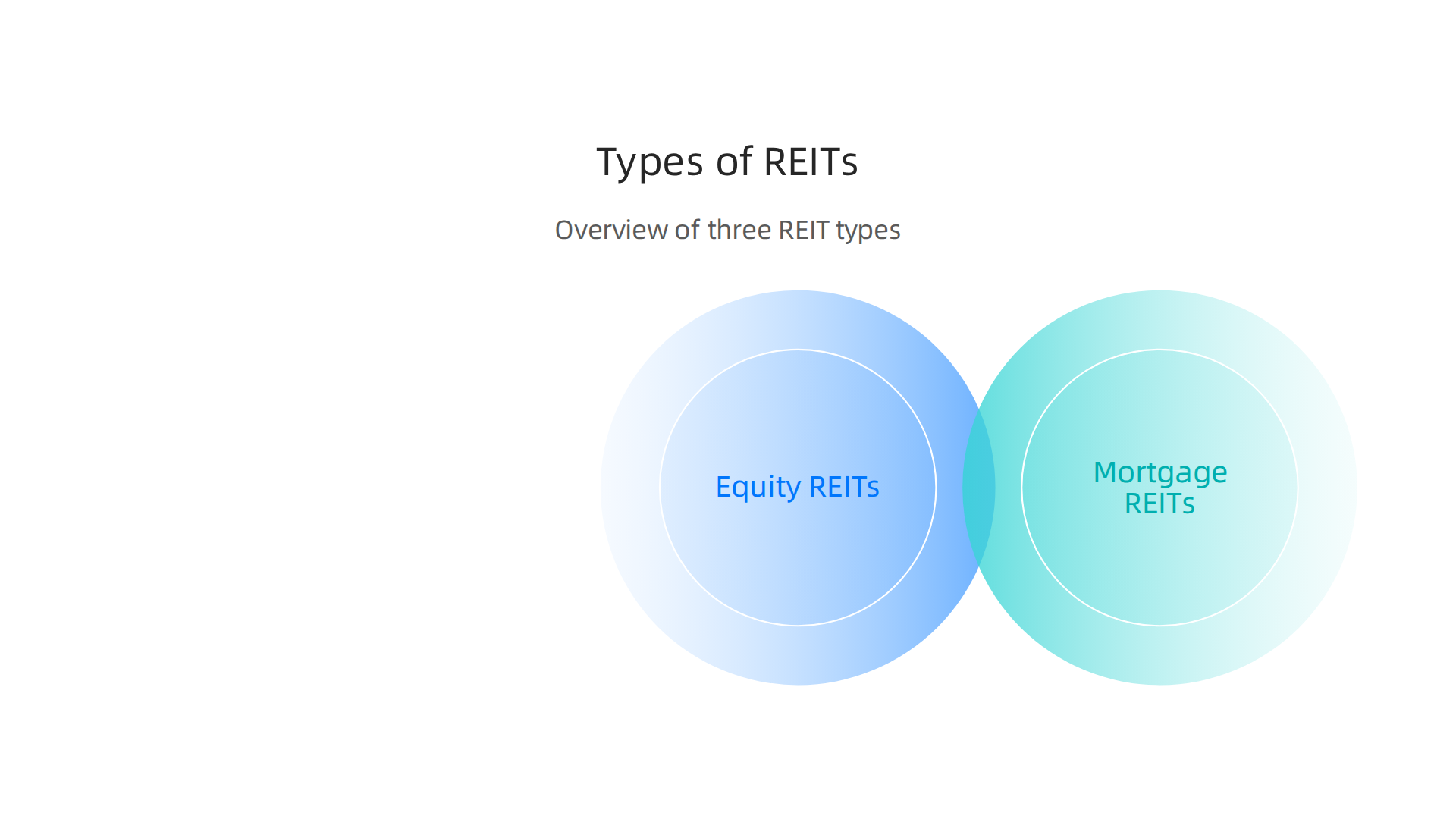
The three categories are equity REITs, mortgage REITs, and hybrid REITs. Think of them as different flavors of the same dessert. All are real estate investment trusts REITs, but they earn money in different ways.
Equity REITs: The Most Common Type
Equity REITs are the most popular kind of real estate investment trust. These companies actually own and operate income-producing properties. They might own apartment buildings, office towers, shopping malls, hotels, or warehouses. The way they make money is simple: they collect rent from tenants and also benefit when the property value goes up over time. The Nareit website explains that equity REITs own or finance income-producing real estate across many property sectors. For most investors, equity REITs are a great way to get steady dividend income with some potential for growth.
Mortgage REITs (mREITs): The Lenders
Mortgage REITs, often called mREITs, do not own physical buildings. Instead, they lend money to real estate owners or buy mortgage-backed securities. They make money from the interest on those loans. This can lead to higher yields, but it also comes with more risk, especially when interest rates change. According to the SEC Investor Bulletin, mortgage REITs focus on providing financing for real estate, not owning it. If you want higher income and are okay with more ups and downs, mREITs might be worth a look.
Hybrid REITs: A Mix of Both
Hybrid REITs do a little bit of everything. They own some properties and also lend money. This gives you a balanced exposure. But it also makes the investment more complex. You have to understand both sides of the business. As the ABCs of REITs from RSM points out, hybrid REITs combine the strategies of equity and mortgage REITs. They can be a good middle ground for someone who wants diversification within a single REIT.
Which Type Should You Choose?
It all comes down to your goals. If you want steady, predictable income with long-term growth, equity REITs are a solid choice. If you are chasing higher yields and can handle more risk, mortgage REITs could be for you. Hybrid REITs offer a compromise but require more research. Before you decide, it helps to get some guidance. For more personalized advice on real estate investment in Dubai, check out our guide on Dubai real estate investment proven strategies for high rental yields. Knowing the differences between these types is key to making smart choices with your money.
How REITs Generate Income and Returns for Investors
By now, you know the main types of real estate investment trusts. But how do they actually make you money?
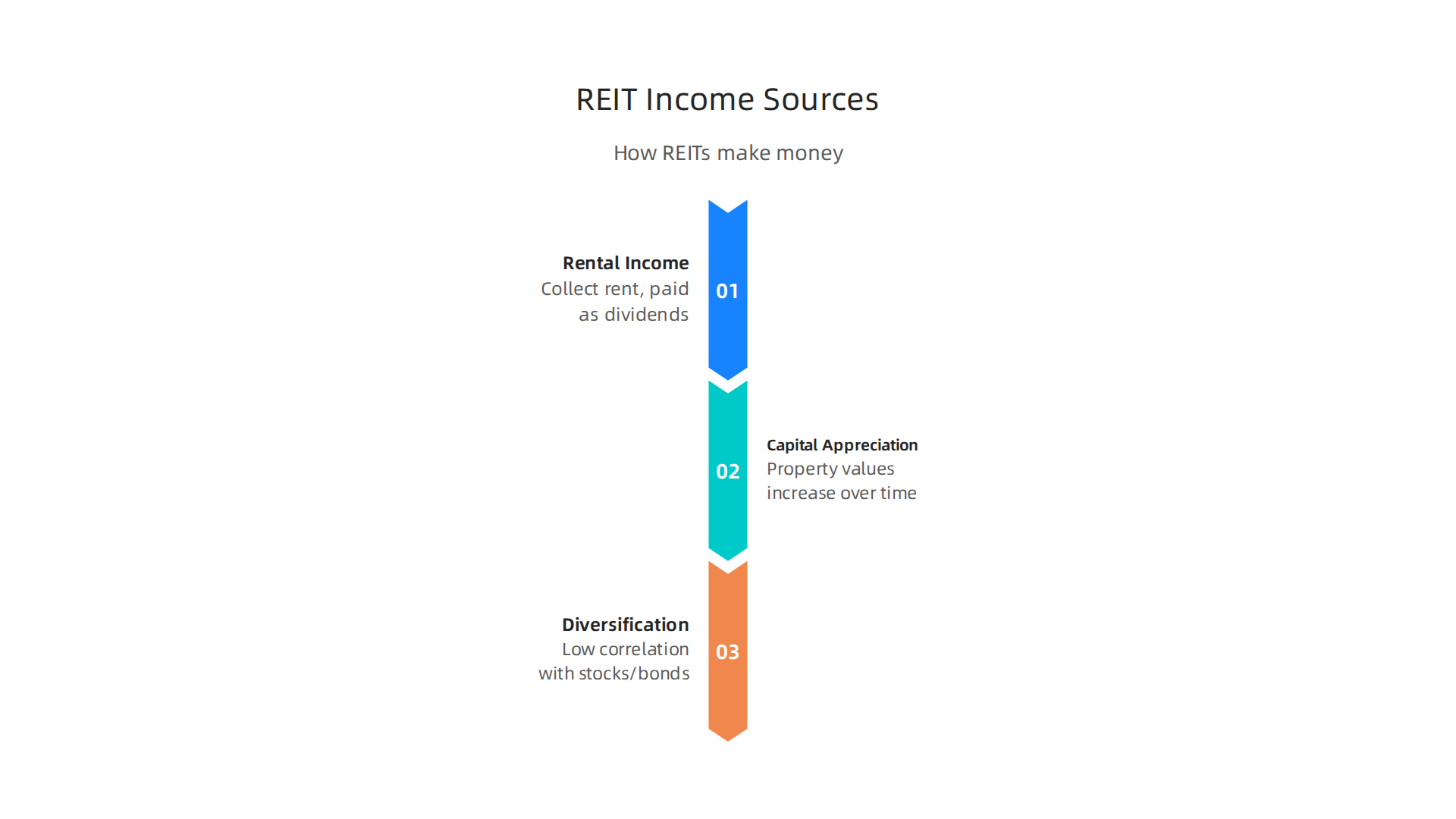
This is where things get exciting. When you understand the money flow, you can choose the best REITs for your goals.
Rental Income: The Main Engine
For most REITs, especially equity REITs, the primary income source is rent. Tenants pay rent each month. The REIT collects that money. Then, the REIT pays out most of it to you as dividends. This is how what are real estate investment trusts deliver steady cash flow to investors.
Here is the key rule. By law, a REIT must pay out at least 90% of its taxable income to shareholders each year. That is a huge number. This requirement is why REITs are known for high yields. Compared to regular stocks or bonds, the dividends can be much larger. As research from Sarwa shows, REITs have outperformed stocks over the past 50, 25, and 20 year periods. This makes them a serious contender if you want passive income.
Capital Appreciation: The Growth Side
Rent is not the only way you profit. Over time, the properties a REIT owns can go up in value. Maybe the neighborhood improves. Maybe the REIT renovates a building and raises rents. When this happens, the REIT shares can also rise in price.
You get two things. You get dividend checks along the way. And you might sell your shares later for more than you paid. The Wharton School has noted that real estate investment trusts reits fall somewhere between stocks and bonds on both risk and return. This means you get decent growth potential without the wild swings of individual stocks.
Diversification: The Hidden Benefit
There is another way REITs help your portfolio. They do not move in lockstep with stocks and bonds. When the stock market drops, REITs sometimes hold steady or even go up. This low correlation is a powerful tool for reducing your overall risk.
According to Nareit, the relationship between REIT performance and Treasury yields changes over time. This unpredictability actually helps you. It means adding REITs to your mix can smooth out the ups and downs. You get better returns with less chaos.
Putting It All Together
Think of REITs as a dual income machine. You collect dividends from rent. You benefit when property values rise. And you get portfolio protection through diversification. The global REIT market is forecast to grow by USD 397.6 billion from 2026 to 2030. That growth means more opportunities for everyday investors like you.
If you want personalized guidance on how to apply these principles to real estate investment in Dubai, check out our guide on Dubai real estate investment proven strategies for high rental yields and growth. Understanding how these income streams work is the first step to building lasting wealth.
REITs vs. Direct Property Ownership: A Balanced Comparison
So you know how REITs make money. Now comes the big question. Should you buy shares of a REIT or buy a physical property yourself?

Both paths lead to real estate exposure, but they feel completely different.
Liquidity: Cash When You Need It
Here is the biggest difference. REITs trade on stock exchanges just like Apple or Microsoft shares. You can sell your position in seconds during market hours. Need cash fast? No problem.
Direct property ownership is the opposite. Selling a house or apartment takes months. You need to list it, show it, negotiate, and close. That process can take three to six months or longer. If you need money quickly, you are stuck.
This instant access to your cash is a huge advantage of understanding what are real estate investment trusts. As research from Sortis Capital explains, REITs offer a level of liquidity that direct real estate simply cannot match. You get the benefits of property without locking up your money.
Diversification: Eggs in Many Baskets
Think about buying a single rental property. That is one house in one neighborhood. One bad tenant or one broken furnace and your returns take a hit.
A REIT flips that around. When you buy shares in a REIT, you own a slice of dozens or even hundreds of properties. You might own office buildings in New York, apartment complexes in Texas, and warehouses in California all at once. That spread reduces your risk dramatically.
According to the Wharton School, real estate investment trusts reits fall somewhere between stocks and bonds on both risk and return. You get the growth potential of real estate without putting all your eggs in one basket. For beginners seeking advice on real estate investment, this built-in diversification is a lifesaver.
Management: Do It or Let Pros Handle It
Direct ownership means you are the landlord. You handle late-night maintenance calls, tenant conflicts, and lease renewals. You can hire a property manager, but that eats into your profits.
REITs take that burden off your shoulders. Professional management teams handle every detail. They find tenants, fix problems, and maximize income. You just collect dividends.
This hands-off approach is ideal if you want to learn more about Dubai real estate investment 2026 proven strategies for high rental yields and growth without becoming a full-time landlord. The REIT does the heavy lifting while you enjoy the returns.
Key Risks and Challenges of Investing in REITs
REITs sound great so far. Easy to buy, instant diversification, and no late night calls about a broken toilet. But let’s be real. Every investment has a dark side.
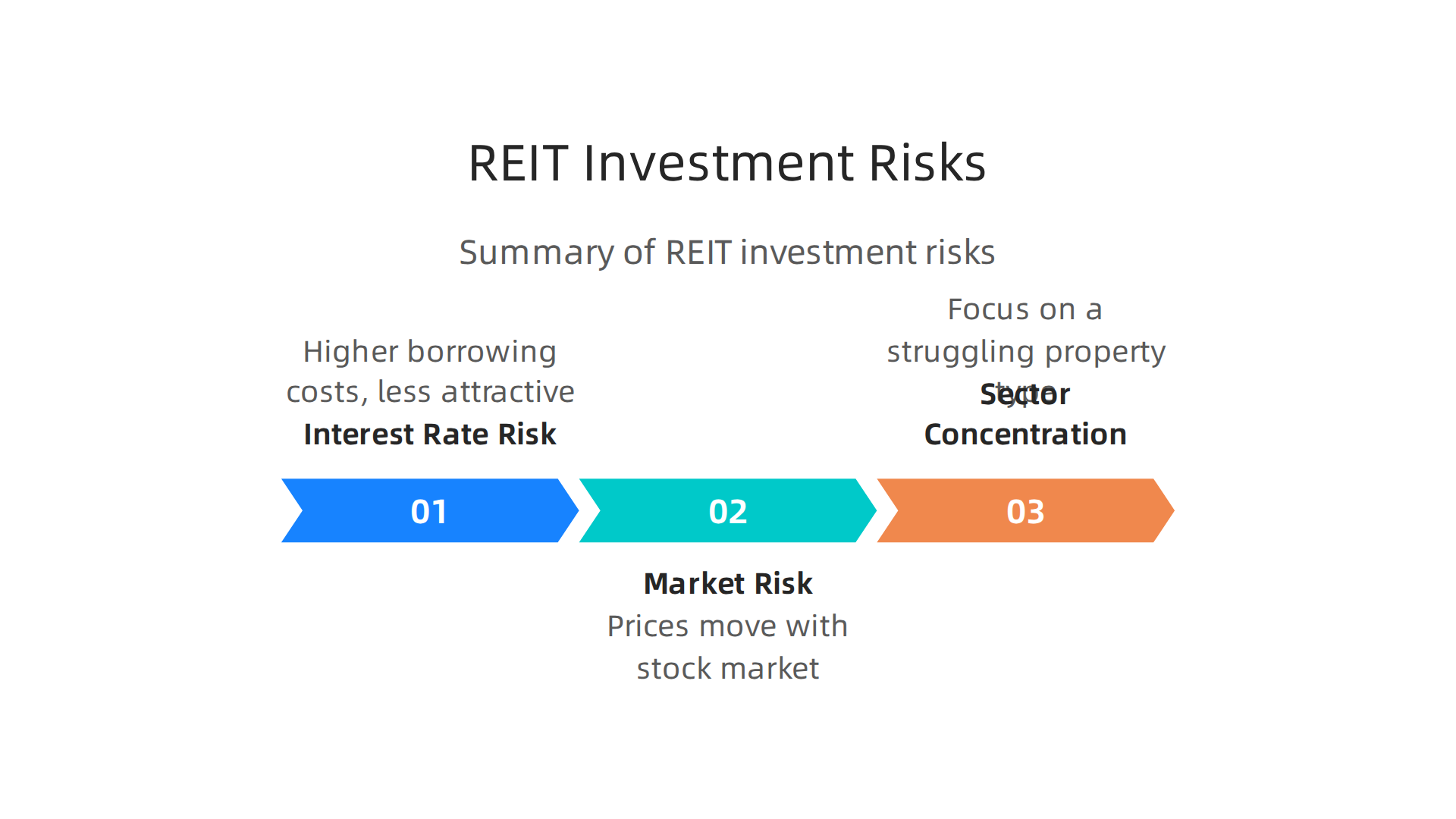
If you want solid advice on real estate investment, you need to know the risks too. Here are the main ones to watch out for.
Interest Rate Risk: The Rate Monster
This is the big one. When interest rates rise, REITs can take a hit. Here is why. REITs borrow a lot of money to buy properties. Higher rates mean higher borrowing costs. That eats into profits and dividends.
At the same time, rising rates make bonds and savings accounts look more attractive. Investors may sell their REIT shares to buy safer options. That pushes REIT prices down. According to research from Nareit, the relationship between REIT returns and Treasury yield changes is real and can go either way. You need to watch where rates are heading.
Market Risk: Roller Coaster Rides
Remember how we said REITs are easy to sell? Well, that comes with a downside. REIT prices move with the stock market every single day. Sentiment, news, and economic fears can swing prices wildly even when the properties themselves are doing fine.
As the Wharton School explains, real estate investment trusts reits fall somewhere between stocks and bonds on the risk spectrum. They are not the calm, stable neighbor you might expect from real estate. They can drop 10 percent in a month just because the market is nervous.
Sector Concentration Risk: Not All REITs Are the Same
Here is a trap many beginners fall into. They buy a REIT and think they are diversified. But some REITs only own one type of property. Think office buildings in a world where remote work keeps growing. Or shopping malls as online shopping booms.
If you buy a REIT that focuses on a struggling sector, your returns will suffer even if the overall market is fine. This is why understanding what are real estate investment trusts means looking under the hood. To explore specific market strategies that avoid these traps, check out our guide on Dubai real estate investment 2026 proven strategies for high rental yields and growth.
The key takeaway? REITs are powerful tools. But they are not magic. Treat them like any other investment by learning their risks first.
The Dubai REIT Landscape: Opportunities and Local Regulations
Now that you know the risks, let’s talk about something exciting. Dubai has a growing REIT market that offers some unique advantages. If you are looking for solid advice on real estate investment in the UAE, paying attention to local REITs could be a smart move.
Where Do Dubai REITs Trade?
Dubai REITs are listed on the Dubai Financial Market (DFM), one of the region’s leading stock exchanges.

The DFM was founded back in 2000 and has grown into a hub for investors from all over the world. Today you can find several real estate investment trusts reits trading there, including well known names like Emirates REIT and Al Mal REIT. In fact, the market just got a big boost with the debut of Dubai Residential REIT, which is now the largest listed REIT in the GCC. It manages over 20 residential communities and more than 35,000 homes. That is serious scale.
Who Makes the Rules?
The Dubai International Financial Centre (DIFC) provides the regulatory backbone. The Dubai Financial Services Authority (DFSA) oversees REITs to make sure they follow strict rules. This framework is designed to protect investors and keep the market transparent. According to the DFM’s official listing page, the exchange’s REIT platform lets property owners raise capital without selling their buildings completely, sharing the income stream with investors instead. That is a big deal for anyone wondering what are real estate investment trusts in practice.
Big Benefits for Dubai Investors
Why choose Dubai REITs over others? Here are three standout perks.
Tax transparency. One of the sweetest parts is that REITs are exempt from corporation tax in the UAE. That means more of the rental income flows through to you as dividends. The tax rules were updated in 2025 with Cabinet Decision No. 34, which revamped the framework for Qualifying Investment Funds and REITs. So the system is fresh and investor friendly.
Access to prime local assets. Through a REIT, you can own a slice of Dubai’s best commercial towers, shopping malls, and residential communities that would normally cost millions to buy outright. You get diversification without needing deep pockets.
Sharia compliant options. Many Dubai REITs are structured to follow Islamic finance principles. That opens the door for investors who want to keep their portfolios aligned with their values. The DFM even has a dedicated page explaining how to invest in Sharia compliant real estate through REITs.
If you want to dig deeper into how to make the most of these opportunities, check out our guide on Dubai real estate investment 2026 proven strategies for high rental yields and growth. It covers the local market trends you need to know.
Dubai’s REIT market is still young but growing fast. With a strong regulator, tax perks, and access to world class properties, it is worth a serious look.
How to Start Investing in REITs (in Dubai and Globally)
So now you understand what are real estate investment trusts and why Dubai has a strong REIT market. The next natural question is how to actually buy them.

The good news is that getting started is simpler than you might think. And you have two main paths: going global or staying local.
Global REITs: Your Passport to World Markets
If you want to invest in real estate investment trusts reits from the United States, Europe, or Asia, the easiest way is through exchange traded funds (ETFs). Popular ones include VNQ from Vanguard and IYR from iShares. These funds hold baskets of REITs, so you get instant diversification with a single purchase.
To buy these, you need an international brokerage account. Many online brokers let you trade on the New York Stock Exchange and other global markets. You can also buy individual REIT stocks directly if you prefer picking specific companies.
Dubai REITs: The Local Route
For those focused on the UAE, Dubai offers a straightforward path. You need a local brokerage account on the Dubai Financial Market (DFM). The DFM is one of the region’s leading exchanges, founded in 2000, and it has a dedicated platform for REITs today.
Banks like Emirates NBD offer securities services that let you trade DFM listed stocks. Once your account is set up, you can buy shares in Dubai REITs just like any other stock. The exchange even has a page explaining how to invest in Sharia compliant real estate through REITs, which is helpful if that matters to you.
You can also find ETFs that track the DFM REIT index. That gives you exposure to the whole local market in one go.
Due Diligence: What to Check Before You Buy
Before you put money into any REIT, do your homework. Here is what to look at:
Dividend history. A REIT should have a consistent track record of paying dividends. Check how much they paid each year and whether payments grew.
Management quality. The team running the REIT matters a lot. Look at their experience and past performance.
Sector exposure. Does the REIT focus on offices, homes, malls, or mixed? Make sure the sector matches your outlook. For example, Dubai Residential REIT manages over 20 residential communities and more than 35,000 homes. That is pure residential exposure.
Expense ratios. Lower fees mean more money stays in your pocket. Compare expense ratios across similar REITs.
If you want more detailed advice on real estate investment in Dubai, including how to pick the right assets, check out our guide on Dubai real estate investment 2026 proven strategies for high rental yields and growth. It walks through the local trends that matter right now.
Starting is the hardest part. But once you open that brokerage account and make your first purchase, the process becomes routine. And with both global and local options available, you can build a REIT portfolio that fits your goals.
Summary
This article explains what real estate investment trusts (REITs) are, how they work, and why they matter for investors in 2026 — especially those interested in Dubai. It covers the main REIT structures (equity, mortgage, hybrid), how REITs produce returns through rent and capital appreciation, and the diversification and liquidity advantages compared with owning physical property. The piece also highlights key risks like interest-rate sensitivity, market volatility, and sector concentration, and it describes Dubai’s growing REIT market, regulatory framework, tax treatment, and Sharia-compliant options. Finally, the article walks through practical steps to buy REITs locally on the Dubai Financial Market or globally via ETFs and brokerages, plus the core checks you should run before investing.