
Dubai Real Estate Investment 2026 Proven Strategies for High Rental Yields and Growth
· 23 min read
You have probably asked yourself at some point: how is real estate an investment that actually grows your money?

The answer is simple in theory but tricky in practice. Real estate gives you something stocks and crypto cannot a tangible asset. You can touch it, improve it, and earn passive income from it. And when you pick the right market, the numbers look even better.
Dubai in 2026 is one of those rare markets where opportunity and risk live side by side. Average gross rental yields for apartments sit around 7%, while villas and townhouses deliver about 5%, according to the Dubai Housing Market 2026 report from Engel & Völkers. That is high compared to many global cities where yields barely cross 3%. In affordable neighborhoods, rental demand surged past 20% last year, and apartment prices rose between 9% and 29%, as reported by Khaleej Times. These numbers make it clear why so many expats and high net worth investors are looking at Dubai.
But here is the thing. Investing in Dubai real estate is not all smooth sailing. The market moves fast, and you need to watch for the Dubai property bubble risk. Some analysts predict that oversupply could push prices down 10 to 15% in 2026, especially in certain segments, as noted by international credit rating agencies. On top of that, property management services in Dubai can feel fragmented. It is hard to compare providers, ensure maintenance quality, or handle legal compliance from abroad if you are an expat investor.
That is exactly why we created this guide. We want to demystify the entire process and give you actionable strategies that work in today’s market. We will walk through how to real estate investment step by step, share a real estate investment tip or two, and even show you how to invest in real estate investment trusts as a lower touch option.
If you are serious about making smart moves in Dubai property, start by getting the right help. Compare vetted property managers who can handle tenant handling, leasing, and maintenance for you. That way you protect your returns without the daily hassle.
👉 Compare Providers and find a partner that fits your investment style.
And if you want a complete roadmap first, check out our detailed guide on Dubai real estate investment 2026: proven tips for maximizing your returns. It covers everything from choosing the right neighborhood to structuring your finances. Let us get started.
Understanding Real Estate as an Investment Vehicle
We have seen the numbers. High rental yields. Strong price growth. But it helps to take a step back and look at the engine under the hood. How is real estate an investment that creates real wealth over time?
It comes down to a few basic mechanics that work especially well in Dubai.
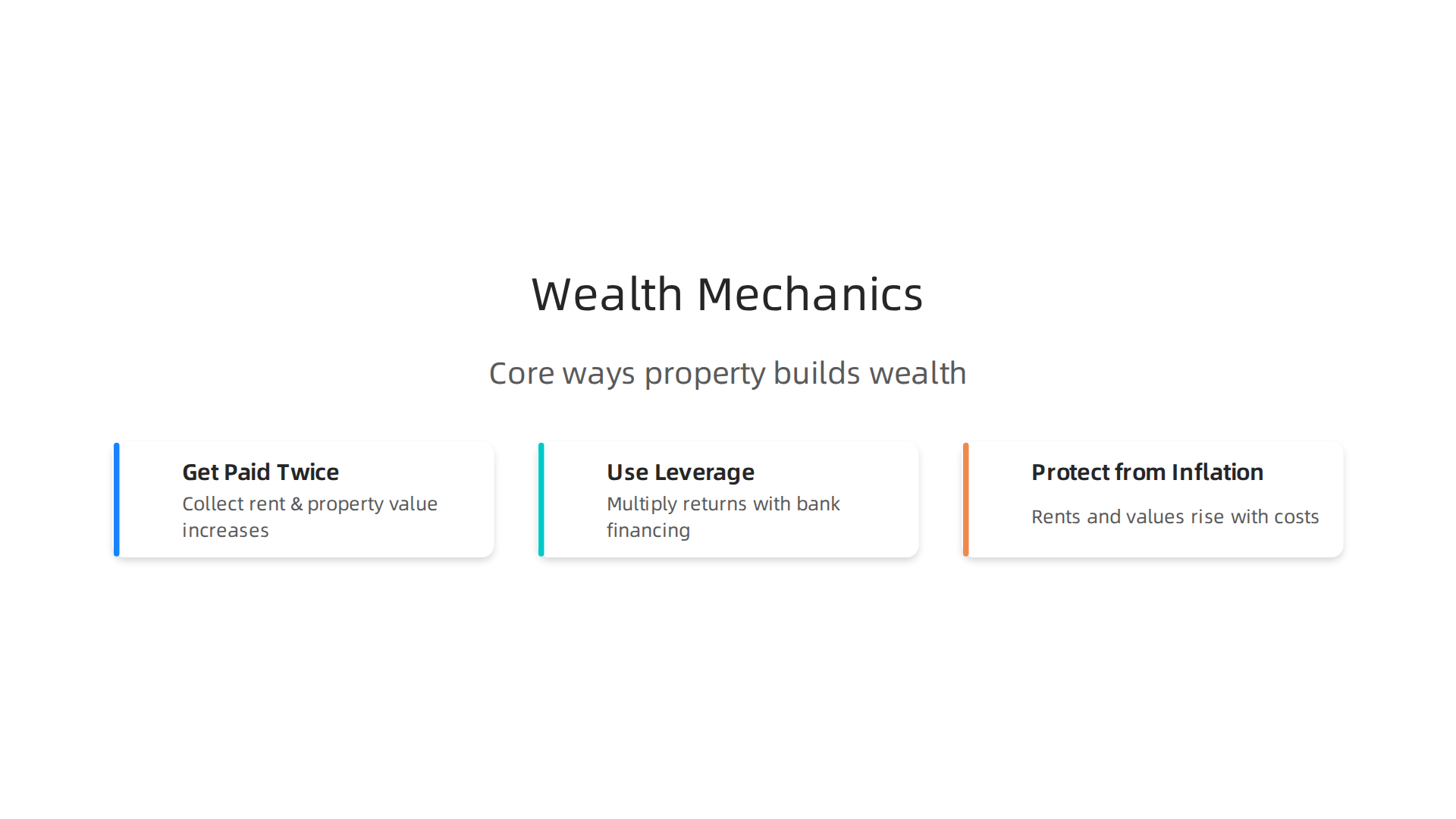
You get paid twice. First, you collect rent. In Dubai, apartments delivered gross rental yields of around 7% by late 2025, according to the Dubai Housing Market 2026 report from Engel & Völkers. That money hits your account month after month. Second, the property itself can go up in value. In affordable neighborhoods, apartment prices rose up to 29% last year, as reported by Khaleej Times. This dual return is the core answer to how is real estate an investment that outperforms many other asset classes over the long term.
You use leverage to multiply returns. You put down a 20% deposit and the bank finances the rest. If the property goes up by 10%, your actual return on that cash is much higher. That is the power of other people’s money working for you.
You protect yourself from inflation. As the cost of goods and services rises, so do rents and property values. This protects your purchasing power in a way cash in a savings account simply cannot.
Dubai makes this even more accessible for foreigners. Freehold ownership laws mean expats can buy property in designated areas and enjoy the same benefits as local investors. You can own a villa or an apartment, collect the rent, and benefit from capital appreciation. The Global Property Guide analysis of the UAE market in 2026 notes that while rental growth has stabilized, the market remains strong for strategic investors.
But understanding how is real estate an investment also means understanding risk. The Dubai property bubble risk is real. Analysts point to potential oversupply that could cool prices by 10 to 15%, as noted by Dubai Estate. This is why picking the right property and the right team matters so much.
Here is the first step. If you are wondering how to real estate investment properly in Dubai, start by securing professional management. You want a partner who handles tenant placement, maintenance, and legal compliance from day one.
👉 Compare Providers and find a management team that fits your investment style.
For a complete roadmap, read the full guide on maximizing your Dubai real estate returns in 2026. It covers everything from choosing the right neighborhood to structuring your finances.
Core Investment Strategies in Dubai
Now that you understand how real estate works as an investment, it is time to pick your path. Every investor asks how is real estate an investment that fits their time, money, and goals. The answer depends on which strategy you choose.
Here are the three main ways to build wealth in Dubai’s market in 2026.
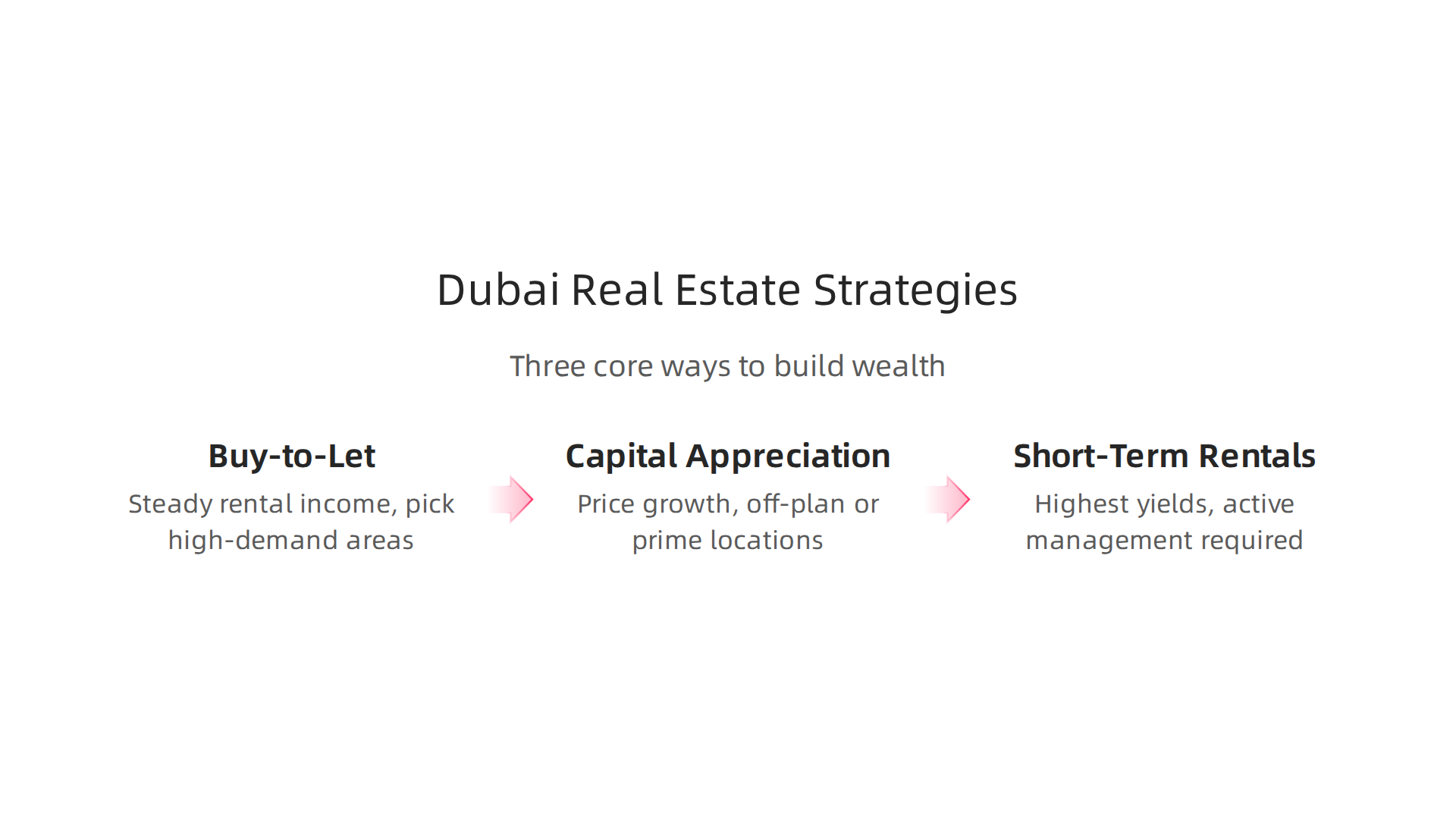
Strategy 1: Buy-to-Let for Steady Rental Income
This is the most common approach. You buy a property, find a tenant, and collect rent every month. The key is picking high-demand areas where people actually want to live. According to the Dubai Real Estate Market 2026 analysis from Banke.ae, areas close to metro stations and new business hubs continue to show strong occupancy rates.
Your job becomes simple: own the asset and let someone else pay down your mortgage while you earn cash flow. A good real estate investment tip is to aim for neighborhoods with a mix of affordable and mid-range apartments, as these attract the most tenants.
If you want a truly hands-off experience, you need a reliable property manager. That is where comparing services helps you avoid headaches.
👉 Compare Providers to find a management team that handles tenant placement and maintenance for you.
Strategy 2: Capital Appreciation through Off-Plan or Prime Locations
Some investors care more about price growth than monthly rent. They buy off-plan (before construction finishes) or pick a prime address in areas like Dubai Marina or Palm Jumeirah.
The Dubai Land Department’s Strategic Plan 2026 aims to make Dubai a world leader in real estate investment. That attracts global buyers and pushes prices up over time.
But appreciation comes with risk. The dubai property bubble risk appears when too many new projects hit the market at once. If you buy at the top of a cycle, you might wait years for values to recover. A safer approach is to combine appreciation with rental income. Even if prices dip, your rent check keeps coming.
For a deeper look at specific areas and price trends, read the Danube Properties Dubai Price Guide 2026. It breaks down apartment costs and payment plans.
Strategy 3: Short-Term Rentals and Holiday Homes
This strategy offers the highest potential yields, often 10 to 15% gross, but it requires more active management. You list your property on platforms like Airbnb or Booking.com, deal with frequent guest turnovers, and handle cleaning and maintenance between stays.
Dubai’s tourism boom in 2026, highlighted in Why Dubai property investment in 2026 offers exceptional returns, makes holiday homes a strong option for areas near the Expo site, beaches, or Downtown. However, regulations require a license, and operational costs eat into your margin.
If you have the time or a good management partner, short-term rentals can supercharge your returns.
Which strategy fits you? If you want passive income, go with buy-to-let and professional management. If you have a higher risk tolerance and longer time horizon, off-plan appreciation works. For active investors, short-term rentals provide a fast cash flow.
Here is a final how to real estate investment tip: start with one strategy, master it, then expand. Do not try to do everything at once.
For a complete roadmap that covers financing, taxes, and exit plans, read the full guide on maximizing your Dubai real estate returns in 2026.
Key Performance Metrics Every Investor Should Know
Picking a strategy is only half the work. The other half is knowing how to measure success. Without the right numbers, you are flying blind. Here are the key metrics that tell you if a property is a good deal or a money pit.
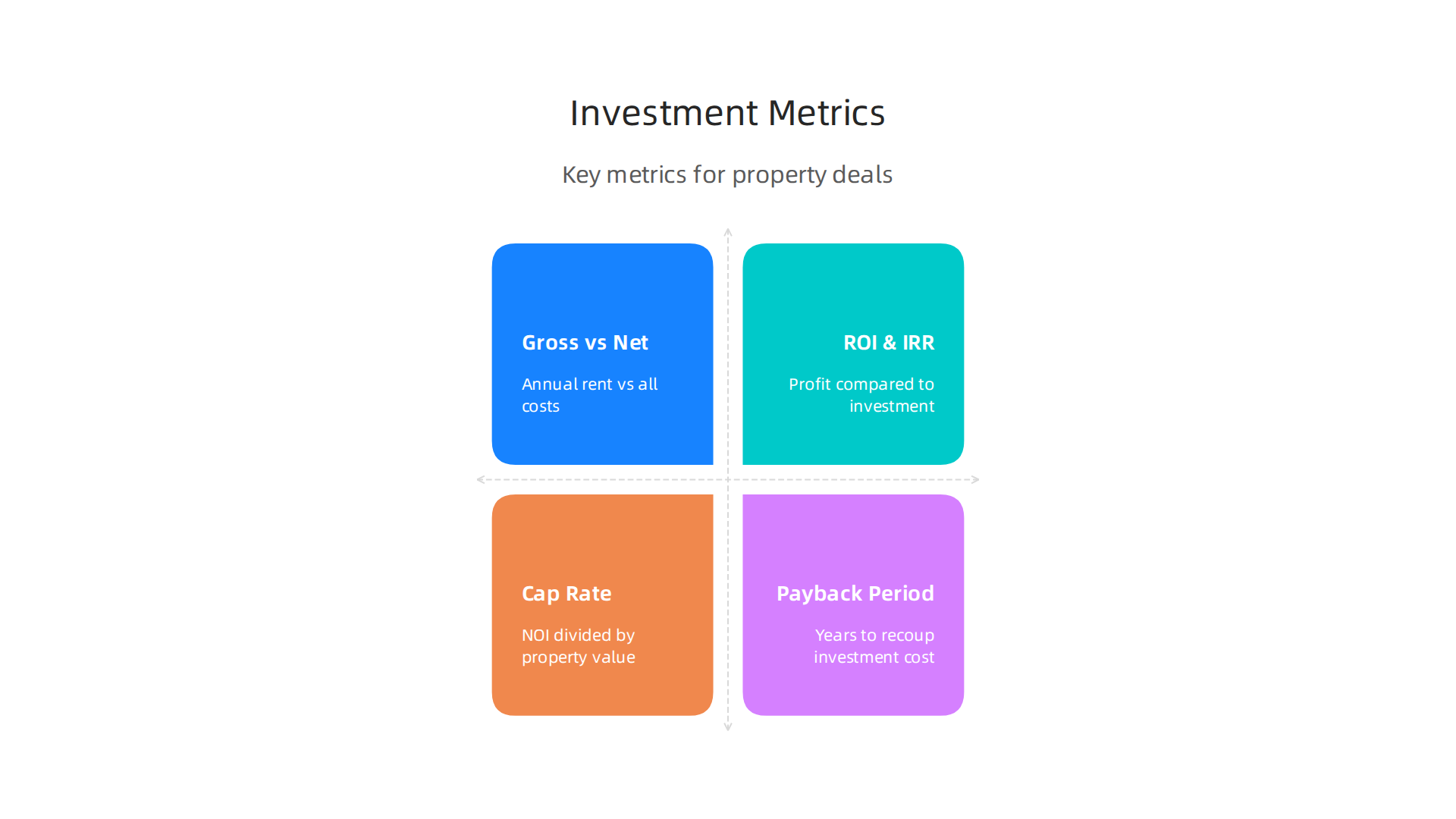
Use them every time you evaluate a deal.
Gross Rental Yield vs Net Yield
Gross rental yield is the easy one. You take annual rent, divide by the purchase price, and multiply by 100. Example: a property that costs AED 1 million and rents for AED 60,000 a year gives you a 6% gross yield.
But that number does not tell the full story. Net yield subtracts all your costs: service charges, maintenance, property management fees, vacancy gaps, and insurance. In Dubai, service charges can eat 10 to 20% of your gross rent depending on the building. That is why a property with a flashy 8% gross yield might only give you 5% net.
A good real estate investment tip is to always calculate net yield first. Use data from the Dubai Real Estate Market 2026 analysis on Banke.ae to compare actual net returns across neighborhoods. The difference between gross and net can make or break your cash flow.
Return on Investment and Internal Rate of Return
ROI tells you how much profit you made compared to what you put in. If you invested AED 200,000 (down payment plus closing costs) and sold the property for a AED 100,000 profit after two years, your ROI is 50%.
But ROI has a blind spot: it ignores time. That is where Internal Rate of Return (IRR) comes in. IRR factors in the timing of your cash flows, like when you receive rent and when you sell. A higher IRR means your money worked harder for you faster.
The Dubai Land Department’s Strategic Plan 2026 aims to make the city a world leader in real estate investment. That push for transparency and regulation helps investors get reliable data to calculate ROI and IRR more accurately.
Capitalization Rate and Payback Period
The cap rate is similar to net yield. It is the net operating income divided by the property value. Used widely for commercial deals, but it also works for residential. It lets you compare properties apples to apples. A higher cap rate usually means higher risk and higher potential return.
The payback period is simple: how many years will it take to earn back your initial investment through net rental income. If you put in AED 200,000 and earn AED 20,000 net per year, the payback period is 10 years. Shorter is better. Areas near new business hubs, highlighted in Why Dubai property investment in 2026 offers exceptional returns, often have faster payback times due to consistent demand.
For a deeper breakdown of specific area prices and yields, read the Danube Properties Dubai Price Guide 2026. It shows actual examples of cap rates and payback periods in popular districts.
Here is the bottom line: Master these four metrics before you buy. A property might look great on the surface, but the numbers tell the truth. If you want a complete roadmap from financing to exit, check out the full Dubai real estate investment 2026 guide. And remember, maximizing net yield often starts with the right property manager. Compare Providers to find a team that will protect your returns from day one.
Where to Invest: Top Dubai Districts and Property Types
Now that you know the numbers that matter, the next big question is where to put your money.

Understanding how is real estate an investment really comes down to matching a location with your goals. Do you want fast appreciation or steady cash flow? The answer decides your neighborhood.
Prime Areas: High Prestige, Lower Yields
Dubai Marina, Downtown Dubai, and Palm Jumeirah are the crown jewels. Properties here hold their value well and often see strong price growth over time. But because prices are high, rental yields are lower. Expect gross yields around 5% to 5.5% for apartments in these areas, according to GuestReady’s 2026 rental yield report. These districts attract wealthy tenants and tourists, so vacancy risks are lower, but the returns per dirham are not as juicy as in up-and-coming spots. If your goal is long‑term capital appreciation, prime is a solid choice.
Emerging Areas: Higher Yields and Growth Potential
For investors who want stronger cash flow, look to districts like Dubai South, Jumeirah Village Circle (JVC), Al Furjan, Dubai Silicon Oasis, and Dubai Sports City. These mid‑market communities consistently deliver gross rental yields of 7% to 8%, as shown in Luxhabitat’s yield analysis. The key reason: lower purchase prices combined with strong rental demand from professionals and families.
A real estate investment tip is to focus on areas near new infrastructure. Dubai South, for instance, sits close to Al Maktoum International Airport and Expo City. As the city expands, so will property values there. The PropertyFinder guide to best places in 2026 highlights that neighborhoods with higher yield percentages often come with a slightly higher risk of vacancy during market dips. But if you pick a spot with solid demand, that risk shrinks.
Choosing the Right Property Type
Apartments are the most common entry point for investors. They are easier to finance and resell. Gross rental yields for one‑bedroom flats in Dubai average around 6.7% to 7% according to Sands of Wealth’s 2026 forecasts. That is roughly double what you would get in London or New York.
Villas and townhouses offer higher rental yields in some communities (especially in emerging areas like Al Furjan or JVC) but require a larger upfront investment. They also attract families who often sign longer leases.
Commercial property (offices, retail, warehouses) can deliver even higher yields but comes with different risks like longer vacancies and tenant fit‑out costs. If you are new to real estate, stick with residential apartments first. Want a deep dive into pricing? Check the Danube Properties Dubai Price Guide 2026 for real examples.
How to Avoid the “Dubai Property Bubble Risk”
Some investors worry about a crash. That is fair. But the market in 2026 is more mature than a decade ago. The Dubai Land Department and new regulations have added transparency. To protect yourself, avoid over‑leveraged deals in areas with oversupply. Stick to districts with strong rental demand and positive job growth. For a complete step‑by‑step strategy, read the full Dubai real estate investment 2026 guide.
Here is the bottom line: Prime areas for safety and appreciation. Emerging areas for cash flow. Apartments for beginners, villas for scaling. And always question the dubai property bubble risk by checking real demand numbers.
Need personal help choosing the right district and property type? Connect with Ayaz Salman on Whatsapp for a free consultation. Or if you already own a property and want to maximize net returns, Compare Providers to find a property manager that knows your area inside out.
The Role of Property Management in Maximizing Returns
So you have picked a district and a property type. Now the real work begins. Because how you manage that property makes a huge difference in your final profit. This is where many investors lose sight of how is real estate an investment in practice. The day-to-day decisions about tenants, maintenance, and legal rules will either protect your returns or eat them away.
You have two main paths: do it yourself or hire a professional property manager. Let us look at both.
Self-Management: The Low-Cost, High-Effort Route
Managing your own property saves on management fees, which can range from 5% to 10% of the annual rent. That is money that stays in your pocket. But the trade-off is time and risk. You become the one who screens tenants, chases late payments, handles emergency calls at midnight, and stays on top of Dubai’s changing rental laws. If you live outside the UAE, this gets even harder. Missing one legal step, like registering a tenancy contract with the Ejari system, can lead to fines or disputes. This is why how to real estate investment success often depends on having the right support system in place.
Professional Property Management: More Cost, More Peace of Mind
A good property management company handles everything. Tenant screening, lease agreements, maintenance coordination, legal compliance, and rent collection. They know the local market and can often keep your property occupied with less downtime. In 2026, with rental yields in Dubai averaging around 6.7% to 7% for apartments according to Sands of Wealth’s forecasts, even a small vacancy period can wipe out your net profit. A manager’s fee of 8% might actually pay for itself by keeping your unit full and your tenant happy.
Here are the key services you should expect from a professional manager:
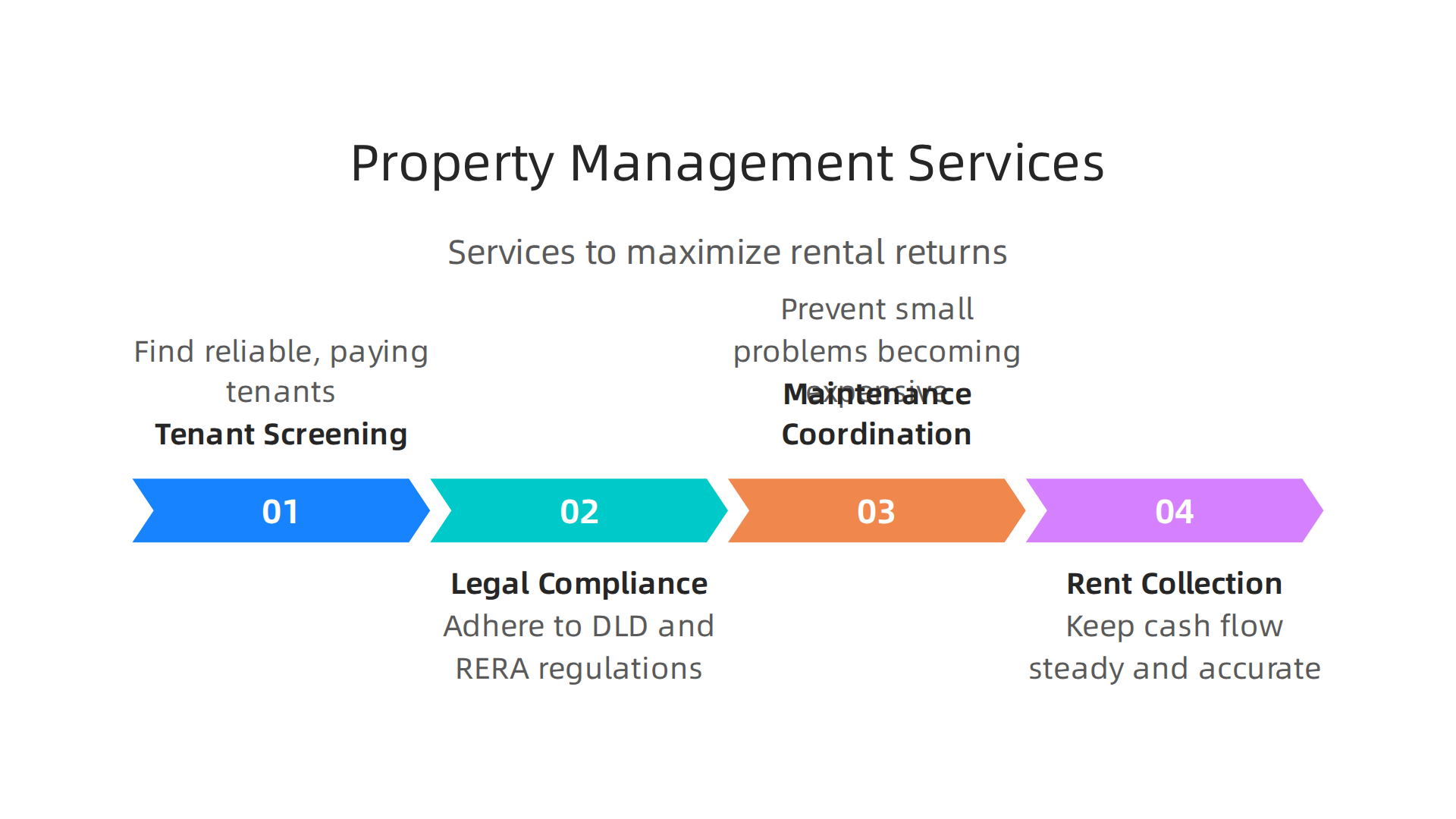
- Tenant screening to find reliable, paying tenants.
- Legal compliance with the Dubai Land Department and RERA regulations.
- Maintenance coordination so small problems don’t become expensive repairs.
- Rent collection and accounting to keep your cash flow steady.
These services do come at a cost. Management fees typically range from 5% to 12% of the annual rent, plus additional charges for leasing or maintenance. But when you factor in the time saved and the reduced risk of costly mistakes, that fee often makes sense. For a deeper look at building your whole investment strategy, read the full Dubai real estate investment 2026 guide.
How Fees Affect Your Net Yields
Imagine you buy a one-bedroom apartment in JVC for AED 800,000. At a gross yield of 7%, the annual rent is AED 56,000. Without a manager, you keep all that minus your own costs for maintenance and vacancy. If you hire a manager at 8%, you pay AED 4,480 in fees, leaving you with AED 51,520. Your net yield drops to about 6.44%. That is still a solid return compared to many global markets, but you need to decide if the convenience is worth the difference. For some investors, it absolutely is. For others, especially those with a single property nearby, self-management works fine.
A real estate investment tip for 2026: start with a trial period of self-management if you are local and have time. Watch how much work it takes. If it feels overwhelming, switch to professional help. Or, if you are an overseas investor, it is usually smarter to go with a pro from day one.
Does all this sound like a lot to juggle? You do not have to figure it out alone. Connect with Ayaz Salman on Whatsapp for a free consultation. Or if you already own a property and want to compare management options side by side, Compare Providers to find the best fit for your specific needs and budget.
Legal and Regulatory Landscape for Foreign Investors
Now that you understand how management affects your returns, the next big step is navigating Dubai’s property laws. Foreign investors often worry about complexity, but the system is actually straightforward once you know the rules. This is where how is real estate an investment in Dubai truly comes into focus. The legal framework protects both buyers and sellers, so you can invest with confidence.
First, you can buy property in designated freehold zones. These include popular areas like Dubai Marina, Downtown Dubai, Jumeirah Village Circle (JVC), and Dubai Hills Estate. According to Pearlshire’s 2026 guide, no residency visa is required to purchase. You simply select your property, sign a sale agreement, and register it with the Dubai Land Department (DLD). The main cost is a 4% DLD registration fee, plus small trustee office and NOC fees (about AED 4,000 if the property is over AED 500,000), as detailed by LYM Real Estate. There is no prior government approval needed for freehold areas.
Second, property ownership can lead to a residency visa. Buying a property worth at least AED 750,000 qualifies you for a 3-year investor visa. If you invest AED 2 million or more, you can apply for the 10-year Golden Visa, which also covers your family. This makes Dubai especially attractive for those who want a base in the region. For a deeper look at how these visa rules fit into your overall strategy, check out the Danube Properties price guide for 2026 to see which developments meet the investment thresholds.
Third, avoid common legal pitfalls. Many first-time investors forget about service charges, which are annual fees paid to the building’s owners association. These vary by development and can eat into your yield if you do not budget for them. Always verify the title deed to make sure the seller owns the property free and clear. If you are buying off-plan, use an escrow account. Dubai law requires developers to place buyer payments in a regulated escrow account, protecting your money if the project stalls. Ignoring this step is a major risk.
A real estate investment tip for 2026: work with a registered real estate agent or legal advisor who understands Dubai’s regulations. They will help you avoid costly mistakes like signing an unregistered contract or paying fees in cash.
The rules are clear, but the process can still feel overwhelming. If you want personalized guidance, connect with Ayaz Salman on Whatsapp for a free consultation. Or if you already have a property in mind and need help comparing management options that keep you compliant, Compare Providers to find the right partner for your investment journey.
Tax Considerations and Financial Incentives
One of the biggest questions people have when learning how is real estate an investment that actually works is, "What about the taxes?" It is a fair question. In many countries, taxes take a huge chunk of your rental income or profit when you sell. But Dubai is different. The financial incentives here are a huge part of why people choose how to real estate investment in this city over others.
Here is the simple truth for 2026. There is no annual property tax, no capital gains tax, and no inheritance tax in Dubai.

This is confirmed by multiple 2026 guides on Dubai property regulations. Think about what that means for you. If your property goes up in value and you sell it, you keep the profit. If you pass it on to your family, there is no tax bill. This single factor makes a real estate investment tip like "buy and hold" extremely powerful here. The only major government cost is the one-time 4% DLD registration fee when you buy, as highlighted in the LYM Real Estate legal guide.
Some investors worry about the dubai property bubble risk or over-leveraging. But with proper financing, you can manage risk well. If you need a mortgage, banks usually ask for a 20% to 25% down payment for expats (and 15% to 20% for UAE nationals), depending on the property value. Interest rates are competitive. Getting pre-approved before you shop helps you stick to your budget and avoid the emotional trap of overpaying. This is a core how to real estate investment principle that protects your capital.
Because there is no annual tax holding you back, your main focus should be on finding a property with strong rental demand and managing it well. This is where understanding the market helps. For a deeper look at what kinds of properties are hitting the required investment thresholds for visas and good yields, check out our detailed Danube Properties price guide for 2026. If you want to make sure you are getting the most out of these tax advantages, you need a solid management plan. If you are ready to take the guesswork out of managing your asset, Compare Providers to find a partner who understands the local market. Or, if you are just starting out and want to know exactly what fits your budget and goals, connect with Ayaz Salman on Whatsapp for a free consultation.
Future Trends Shaping Dubai Real Estate in 2026
So you understand the huge tax advantages of investing here. But what is coming next? Keeping an eye on the big trends helps you make smarter moves.

It is not just about buying any property. It is about buying the right kind of property that will stay in demand as the city evolves.
Technology and PropTech are changing how you buy and manage property. In 2026, blockchain is not just a buzzword. The Khaleej Times reports that blockchain-driven tokenisation is set to transform the market. That means you might soon buy a fraction of a high-end villa instead of the whole thing. This opens up how is real estate an investment for people with smaller budgets. Smart contracts also make transactions faster and safer. No more waiting weeks for paperwork to clear. How to real estate investment is getting easier every year thanks to these tools.
Sustainability is no longer optional. It is the new standard. Developers in Dubai are racing to meet green building regulations. The Gulfland Property forecast points to a big shift toward sustainable and green buildings. Properties with energy-efficient systems, solar panels, and better insulation are becoming more popular. Tenants love them because they save on utility bills. Investors love them because they hold value better. If you want a real estate investment tip that will age well, look for buildings with strong green credentials. They attract higher quality tenants and lower vacancy risk.
The Expo 2020 legacy is still alive and growing. New free zones and mega-projects like Dubai South and the Expo City district are pulling in businesses and residents. The Gulf News analysis mentions that vacancy rates are expected to average around 12% in 2026, with variation across the year. Areas tied to these mega-projects tend to have lower vacancies because they offer jobs and lifestyle perks. So do not just buy anywhere. Think about which neighborhoods are benefiting from long-term government plans.
If you are wondering how to position yourself for these changes, the best move is to get expert advice. A professional can help you spot the right opportunities before everyone else jumps in. For a deeper look at the market and proven strategies, check out our Dubai real estate investment guide for 2026 with practical tips for maximizing returns. And if you want personal help navigating these trends, connect with Ayaz Salman on Whatsapp for a free consultation. He can show you exactly where the market is heading and how you can benefit.
Summary
This article explains how real estate functions as a wealth-building investment in Dubai’s 2026 market, highlighting why the city attracts global buyers and expats. It covers core mechanics—rental income plus capital appreciation—how leverage and inflation protection amplify returns, and the specific yields you can expect for apartments, villas and short‑term rentals. The guide walks through three practical strategies (buy‑to‑let, off‑plan for appreciation, and holiday lets), the key performance metrics to evaluate deals, and the role of professional property management in protecting net yield. It also outlines legal steps for foreign buyers, visa thresholds, typical costs (like the 4% DLD fee), and tax advantages that make buy‑and‑hold compelling. Finally, the article flags risks such as oversupply and the Dubai property bubble risk, and points to future trends—PropTech and sustainability—that will shape smart buys going forward.